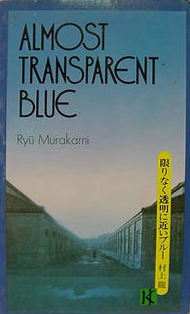
Almost Transparent Blue by Ryu Murakami

The first page of this essay contains introductory information and my experiences reading it repeatedly. The second page is about its central event/theme. The third page is about its tone. The fourth page is an index of characters. The fifth page is an index of notable items. The sixth page contains “miscellaneous notes.” The seventh page is a summary of an orgy. The eighth page contains my thoughts about this essay. The ninth page is an outline that is referenced throughout this essay via [#]s.
Feb. 1, 2011
Tao Lin is a writer living in Manhattan, NY.

Almost Transparent Blue (1976) was written by Ryū Murakami (b. 1952) while he was a student at Musashino Art University, where he was enrolled in the sculpture program. It was his first novel and was awarded the Akutagawa Prize (Japan’s “most sought after” literary prize; previous winners include Kobo Abe and Kenzaburo Oe) and sold ~1.2 million copies (~1% of Japan’s population at-the-time) in six months. In comparison Less Than Zero (1985) sold ~50k copies (~.021% of America’s population at-the-time) in twelve months.

It is 127 pages in English, set over seven days in early 1970s Japan near an American air force base, near Tokyo, and is written in past-tense first-person. The narrator, Ryū, is 19 and has a vague relationship with Lilly, a maybe former-fashion-model and maybe current-prostitute who works in a bar/restaurant. Most scenes are of Ryū and Lilly talking and using drugs or Ryū and his other friends, separate from Lilly, talking and using drugs, mostly in his apartment. One scene is an orgy and one scene is an outdoor concert. About halfway into the book Ryū and Lilly ingest mescaline and drive without a plan in a thunderstorm. The book ends with a one-page letter from Ryū to Lilly that begins “Lilly, where are you now? I think it was four years ago, I tried going to your house once more, but you weren’t there. If you read this book, get in touch with me.”

SINGLE-SENTENCE EXCERPTS

The red ceiling light was reflected on the surface of the brownish vomit on the newspaper.

Moko said, “Ryū, put on some music, I’m sick of just fucking, I think there must be something else, I mean, some other ways to have fun.”

I could see into the kitchen from where I sat.

The Nikomat lens reflected a dark sky and a small sun.

Hey, just like butterflies, said Reiko, taking a piece of the cloth and spreading butter on Durham’s prick.

Bob’s huge cock was stuffed all the way into Kei’s mouth.

After rubbing her body with a piece of bacon, Jackson sprinkled on vanilla extract.

Even when I gently peeled the band-aid off her ass, Moko didn’t open her eyes.

Then he turned to me—my finger still in Moko’s ass—and said, Last night when you guys were messing around I got a straight flush, you know, really right on, a straight flush in hearts—Hey, Kazuo, you were there, you can back me up, right?

From where I stood I could hear words like “pigsty” and “marijuana.”

The inside of the train glittered.

Reiko stood up, her face greenish pale, muttered, What time is it now, what time is it? To no one in particular, staggered to the counter, took the whiskey from Kei’s hand, poured some down her throat, and had another violent fit of coughing.

Without answering she crunched and swallowed five Nibrole pills.

HOW I LEARNED ABOUT IT

I think I learned of Ryū Murakami (b. 1952) when looking at books by Haruki Murakami (b. 1949) in 2002 or 2003. The back cover of Ryū Murakami’s books said “renaissance man” and that he’s been a movie director (of his own books), a talk-show host, played in rock bands. The next six to eight years I read maybe ten Haruki Murakami books, one Haruki Murakami biography, zero Ryū Murakami books. Sometimes I thought things like “what do people think about them having the same last name, similar publishing credits, similar age” and didn’t think anything except maybe “seems…something” or “seems…interesting.”

At some point, in 2009, I think, I read Snakes and Earrings (2003) by Hitomi Kanehara (b. 1983) and liked it and learned that Ryū Murakami was on the prize committee that awarded it—and The Back You Want To Kick (2003) by Risa Wataya (b. 1984) which is not available in English—the Akutagawa Prize in 2003 (notably, as previously the youngest winners were all males over 23) and was quoted as saying “easily the top choice, receiving the highest marks of any work since I became a member of the selection panel.” Around this time I also read somewhere that Almost Transparent Blue was about self-destructive, apathetic, “lost” youth—which is how a certain kind of book I like reading is usually inaccurately, I feel, described.

FIRST READING

I had very little sense of time, due to a lack of connectors like “two days later” or “one week later,” and vaguely intuited that the events occurred over weeks or months and maybe were not linear. I felt that the book might be a series of self-contained scenes and that the author maybe didn’t consider chronology or plot when writing it, but simply related what he viewed as interesting scenes. I didn’t feel that having a sense of time, on the day/week/month level, would affect how I felt about the book, and was mostly focused on tone, I think.

I felt somewhat surprised by the orgy. I felt overall that the book was funny, interesting, readable, and had successfully avoided “stock phrases.” Near the end, in [19], things seemed to become more abstract, and I read the last ~20-pages less attentively, viewing it as a tonal aberration, caused by the author maybe feeling pressure to “do something.”

SECOND READING

I reread it a few months later—April or May, 2010—for this essay, sort of idly, from something like 4AM to 7AM, lying on my bed, sometimes typing notes onto my MacBook. I noticed that some scenes contained details that referenced other scenes, in a manner that I quickly began to “sense” that the book was tightly-structured and plotted—that Ryū Murakami had a clear sense of the book’s movement and each of the characters’ personalities and histories—but in a manner that would not be discernible to me unless I outlined it, in part due to the large number of characters. I felt excited to read the book with increased attention, knowing I probably wouldn’t find any sentences that were contextually incoherent, physically contradictory/impossible, or tonally inconsistent.

Instead of “dismissing” certain sentences whose intentions I didn’t immediately comprehend I began to focus on those sentences more, viewing them as interesting rather than vaguely or carelessly written, in the same manner that if I’m remembering one week of my life where I did a lot of things with a lot of different people I would view details that were more difficult to assimilate into my memory as the more interesting—and ultimately more memorable—details, I think.

I noticed that the narrator focused on describing (to the reader) exterior things, like cockroaches or light filaments, while engaged in dialogue—even when he was the one speaking—in a manner that made me feel calmly emotional, maybe simply because the narrator, in his ability and motivation to describe things that seemed irrelevant to his thoughts and the thoughts of the people around him, with interest and detachment, seemed calm. I felt less that the book was funny and more that it was emotional. I noticed that “veins”/”lines” were frequently described.

THIRD READING

I focused mostly on creating the outline. I numbered each section and noted when a detail referenced another detail. I began to feel that it was written beginning to end, initially, then edited repeatedly, and probably that there were some scenes prior to where the book currently begins, and after where the book ends, that were deleted, because the references were both forward and backward and sometimes seemed to reference things before page one. I think I also made the list of characters and began noticing that each character—and each of the three romantic relationships—seemed to have their own “plot,” or movement, or concern, that was consistent and “not forgotten” throughout the book.

While making the outline I discerned that the book is set at the beginning of Summer, over seven days, which surprised me, I think. It seems obvious, now, to some degree, that it was set over days, because the same pineapple—first referenced in [2], as “an old pineapple” whose “cut end had gone black, completely rotten”—is referenced throughout and in the last sentence of the book before the one-page “Letter to Lilly.”

I felt like I was studying a person, in that I knew some things might not seem coherent from certain perspectives, with limited information, but was able to assume that from a large enough perspective, with enough information, everything would seem coherent, which increased my interest in the book. Similar to if I saw something anomalous on the street, like a neon-green llama, I wouldn’t lose interest in concrete reality, but would likely have increased interest, because I would assume there was an ultimately coherent—and probably interesting, funny, or emotional—reason why the llama was there and why it was neon-green.

FURTHER READINGS

I noticed that the narrator (Ryū remembering the book’s events), as opposed to the character (Ryū living the book’s events) seemed notably focused on the relationships and emotional states of other characters in the book—for example in [3] Ryū is distracted and doesn’t ask Reiko any questions about her “specimen book,” despite her seeming very interested in it and seeming to want to talk about it and even saying she wants to show it to him. Because the chapter ends with “Reiko just stared at the rails,” and other details, maybe just that Ryū ignoring Reiko was shown but not explained, I felt that the narrator either felt some kind of sympathy with Reiko or simply viewed Reiko being neglected as interesting and worth conveying objectively, which made me feel emotional.

I noticed that most scenes with social interactions had instances where people were ignored, and that the narrator seemed to convey these instances—or they were conveyed as a side-effect of describing social situations with equal and accurate focus on each person, which naturally reveals that some people were ignored—but did not comment on them. I felt that people seemed to like Ryū because he seemed to be the most observant and socially aware, and least antagonistic, maybe, character in the book. The narrator, calmly describing things, seemed like an even more observant and socially aware version of Ryū, which was calming to read, I think.
Cataloged in

Text Size:

A | A | A

  • JamesFranco'sEgo

    long story bro

  • shoehorn

    “Sometimes I felt encouraged to continue by a feeling that I now felt more excited to write fiction, and that if I read an essay like this by someone else, on the internet, I might also feel more excited to write fiction.”
    i think you accomplished your goal.

  • http://www.facebook.com/profile.php?id=1363230138 Michael Koh

    “I could see into the kitchen from where I sat.”

    There is something about this phrase that I think is genius.

  • http://heheheheheheheeheheheehehe.com/ tao
  • http://heheheheheheheeheheheehehe.com/ tao

    thanks

  • http://heheheheheheheeheheheehehe.com/ tao

    hey

  • Interested

    Brilliant article.

    I would love to know more about “The Back You Want To Kick” by Risa Wataya

  • Nunsypher

    I can't wait to read your next novel. Read Philip Roth too :)

  • http://heheheheheheheeheheheehehe.com/ tao

    i think it isn't translated to english

  • http://www.critiquemanque.org Morgan

    I've never read “Almost Transparent Blue” so I only wanted to read parts of this. Now I want to go read the book so I can finish this essay.

  • mario

    takashi murakami.

  • http://david-fishkind.com David Fishkind

    nibrole seems so sweet

  • http://twitter.com/mungofrench kdub

    this is extremely interesting and i'm probably going to read it again later. slowly.

  • http://twitter.com/HopelessMuffins BK

    I love this. absolutely.

  • http://tomhankssuperfan.blogspot.com megan boyle

    “I think that scene is 'touching' to me because—by seeming to have no purpose except to non-rhetorically relate what seems, to me, like a memory—it promotes, or is evidence, to me, that a single specific experience that doesn’t cost anything, and has no effect on anyone that isn’t involved, and that doesn’t have to be known by anyone else can be 'worth more' to a person than years of comfort or love or accomplishment or millions of dollars or the respect and admiration of thousands. That a single person, or two people, using only themselves and each other, can easily create an intense, unrecorded, unshared memory that is more emotional, memorable, and affecting than winning the lottery or getting a masters degree or even 'falling in love,' maybe, seems 'beautiful' and exciting and affecting to me. I think I’ve had experiences like this even when alone, and even when feeling conventionally 'negative' feelings, like being very lonely or feeling extremely desperate. These moments—rather than 'accomplishments' or other hierarchal activities, or even some form of long-lasting comfort or calmness, or something—seem to be what I 'want' most, if I want anything, in life, based on what I know currently. When I’m aware of this, and believe it, to a certain degree, I feel calm, I think.”

    me too…

    good job

    viral ass transparent blue

  • http://www.smokingonanemptystomach.blogspot.com Jordan

    i felt inspired to change, i think, or 'remembered,' rather, a 'calmer, more [something] “version of myself”' that i seem to only be able to concretely associate with 'working on things in the library' or 'being alone in my bedroom working on things in a voluntary, “camly excited” manner,' that i have maybe not experienced in the past few days, after reading this essay

    i enjoyed reading your 'slimmed down' version of his conversation with 'okinawa'

    i felt excited about the possibility of participating in an orgy, i think, or excited, possibly, about something else, while reading your summary of the orgy in the book

    good job bro

  • http://twitter.com/rislynsey christopher lynsey

    Monumental.

  • Hilson

    i am pretty excited to read this, i wrote my senior work on this book a couple years ago.

    is there anyway you can put it together in a printable format. i want to read off the computer screen, on paper, at a place convenient to me such as my desk or toilet.

  • http://wayindie.blogspot.com kelly huckaby

    about 3/4 through reading this for some reason i remembered being 12 years old and sitting alone at the front of the bus on the way to school, feeling very sad and lonely after having returned from visiting 40ish cousins in malaysia and trying not to cry the whole way.

    i kept thinking “if somebody tries to talk to me i'm going to tell them my cat died.”

  • http://heheheheheheheeheheheehehe.com/ tao

    sweet

    interesting…

    sweet

  • http://heheheheheheheeheheheehehe.com/ tao

    if you email me at binky.tabby [at] gmail.com i can email you it in one i think

    maybe i can add a page 9 that has everything

  • http://heheheheheheheeheheheehehe.com/ tao

    sweet

    i can mail you my copy for $5 paypal

  • http://heheheheheheheeheheheehehe.com/ tao

    my next novel

    sweet

  • http://heheheheheheheeheheheehehe.com/ tao

    sweet

  • http://heheheheheheheeheheheehehe.com/ tao

    good job changing ” to '

    sweet…

  • http://heheheheheheheeheheheehehe.com/ tao

    sweet sweet

  • http://heheheheheheheeheheheehehe.com/ tao

    chewy ass nibroles

  • http://heheheheheheheeheheheehehe.com/ tao

    seems like i imagine you in an orgy 'wandering around' with a 'glassy' eyeballs…sort of with a somewhat 'tense' neck/head area…slowly moving around, walking, almost with tears on your eyeballs

  • http://heheheheheheheeheheheehehe.com/ tao

    sweet

    bk

  • http://heheheheheheheeheheheehehe.com/ tao

    ryu murakami's goodreads 'bio':

    'Ryū Murakami is a Japanese novelist and filmmaker. He is not related to Haruki Murakami or Takashi Murakami.'

    hehe

  • bob

    I think you got an A on this essay at nyu

    not always good but sometimes great.

    thx

  • Robertbenesh

    I'm currently reading the Japanese version of this (as a part of my dissertation) after a few reads through in English, and I certainly feel that the balance between the perspective of the narrator and the perspective of the character have changed across translations, but I was having difficulty pinning it down. Your writing on the subject was very clear and concise and helped me greatly in understanding these differences. I find it to be very strange timing that you posted this in a time when I am focusing on this work so heavily.

  • http://heheheheheheheeheheheehehe.com/ tao

    sweet…

    i feel interested in the difference re english/japanese, if you would like to share your thoughts

  • Robertbenesh

    It's somewhat difficult to explain without spiraling into detail, but one of the main features I found was that the character of Ryu seemed somewhat more sympathetic and caring toward Reiko, and the narrator's perspective seemed something more–to me, like a sense of loss because of a love he allowed to escape him. As if, in retrospect, he feels guilt for not attempting to build a romantic bond between him and Reiko, realizing after the event that she was much more important to him than he originally understood. There seem to be several moments like this one where the perspective of the narrator Ryu seems to indicate that he wanted to revisit this time of life through this piece of work to better understand the opportunities he missed and the experiences that still weight heavily on him. But then again I could be making all this up.

  • http://heheheheheheheeheheheehehe.com/ tao

    thanks for sharing your thoughts, i felt that the narrator was more sympathetic toward reiko than the character, and that the narrator was more sympathetic because in retrospect he felt that reiko probably liked him in a way that he didn't like her, and simply sympathized with that, maybe as a vicarious source of sympathy in whatever unrequited situation he might currently be in (maybe he views lilly as an unrequited situation currently), or something

  • Chillwave Gonzales

    Having insomnia, and am chilling with this.

  • Nicholas

    just ordered a copy off amazon. awesome essay, tao! very impressed :)

  • http://twitter.com/faizthoughts Faiz Khan

    “There doesn’t seem to be any critique of society, but mostly only of existence, or of self, or of seemingly nothing, in this book.”

    this sentence made me feel 'very bleak'

  • http://popserial.tumblr.com stephen

    I liked this a lot, Tao. I'm glad you wrote it. After reading Ryu Murakami's story in Zoetrope, I'm very interested in reading more by him. The section of your essay that Megan quoted in her comment, that section made me feel gratified and excited. Great job bro

  • http://www.critiquemanque.org Morgan

    That's a good deal. Will you sign it?

  • http://twitter.com/vickylimitless Vicky Lim

    I liked this essay, particularly the moments of doubt and encouragement expressed on page eight, which is how I feel often when writing an essay.

  • http://kumquatparadise.tumblr.com aaron nicholas

    i…uh…skipped straight to page 7

  • jejune

    thanks for writing this, i appreciated it, especially the paragraph in which you explain why you were touched by the novel.

    i was surprised that the characters listened to luiz bonfa while having an orgy.
    http://www.youtube.com/watch?v…

  • buttercup mcgillicuddy

    found the nancy andrew translation online in .pdf format and plan to read [9] upon completing the novel

    also ['in-line', i think, with my interests] found this clip of the film version http://www.youtube.com/watch?v… but could not find any torrents, dvds, streaming videos, etc. and feel desperate

    i enjoyed this analysis, tao, and feel inspired to write more fiction after reading it

    based on your receptiveness to this author, and based on previous japanese literature i've read, i perceive ryu murakami as [sort of] the 'most-underground' author who writes in a form and with similar intent/interests as oe and abe, which i feel excited to now be exposed to. thanks

  • http://heheheheheheheeheheheehehe.com/ tao

    chillwave gonzales

    sweet

  • http://heheheheheheheeheheheehehe.com/ tao

    hi nicholas

    sweet

  • http://heheheheheheheeheheheehehe.com/ tao

    hi faiz khan

    sweet

  • http://heheheheheheheeheheheehehe.com/ tao

    hi stephen

    sweet

    enjoyed reading your comment

    glad you felt gratified and excited

    http://www.yomiuri.co.jp/intvi…

  • http://heheheheheheheeheheheehehe.com/ tao

    hi vicky

    sweet

  • http://heheheheheheheeheheheehehe.com/ tao

    hi buttercup

    sweet

    enjoyed reading your comment

    i think ryu murakami is 'really famous' in japan (re 'most-underground')

  • http://heheheheheheheeheheheehehe.com/ tao

    i like it, seems almost 'emotional,' luiz bonfa

    sweet

  • Jonny Ross

    really enjoyed this. good primer, or something. excited to read the book now.

  • Jonny Ross

    philip roth

  • http://newhandsweepstakes.com/2011/01/20/american-idol-is-awesome/ Brian McElmurry

    I liked this part too. Seems transcending.

  • http://newhandsweepstakes.com/writings/tijuana-story-by-brian-mcelmurry/ Brian McElmurry

    Amazing essay! It seems very western. Inspired me in ways, to write, and read that book. Have you read “No Longer Human” by Osamu Dazai http://en.wikipedia.org/wiki/O…. If I remember, from a young age the narrator didn't feel empathy or 'human', and the story is told in three sections with notes at the beginning from the person whom found the manuscript. Her is an 'esay rider' living off of women and using drugs/drink. He tries to commit suicide with his wife/girlfriend, by drowning and he lives and she dies. The author did this in real life. The books seems based on memory also. Damn good man!

  • http://heheheheheheheeheheheehehe.com/ tao

    sweet

    yes, i read 'no longer human,' i remember liking it

    i don't remember it well, have looked forward, the past 2-4 years, to rereading it at some point

  • almostassblue

    thanks for writing this

Recently Cataloged